Google Ads
Paid Promotion
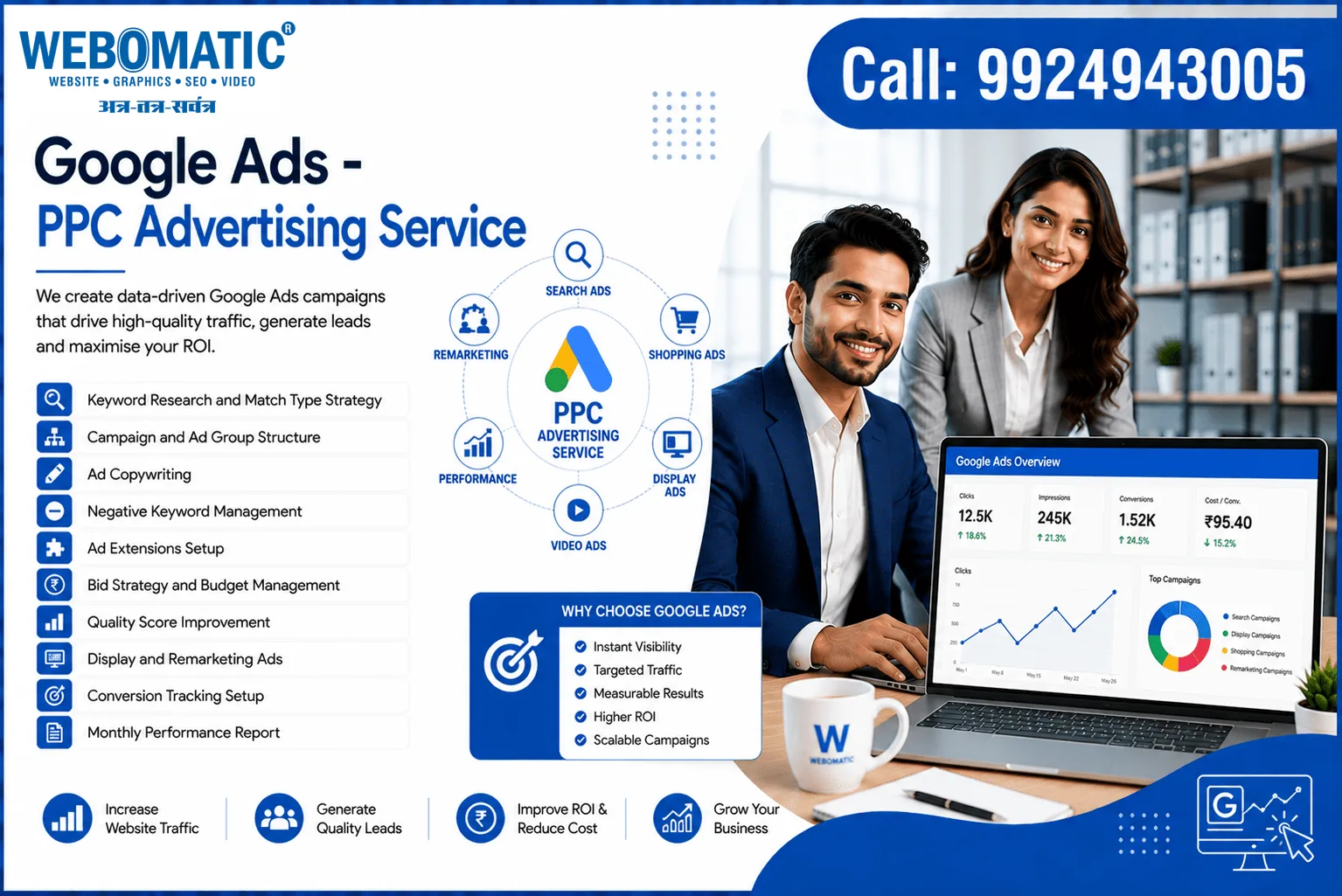
Google Ads (formerly Google AdWords) is the most powerful paid advertising platform in the world. When someone searches for your product or service on Google, your ad appears at the very top of the results - above all organic listings. This means you get in front of people who are actively looking for what you offer, right at the moment they are ready to buy or enquire. Webomatic's Google Ads service covers keyword research, campaign setup, ad copywriting, bid management, quality score improvement, landing page guidance, and detailed performance reporting to maximise your return on every rupee spent.
- Google Search Ads to appear at the top of Google results for your keywords
- Keyword research targeting high-intent buyer keywords in your industry
- Compelling ad copy written to maximise click-through rate and quality score
- Negative keyword management to prevent wasted ad spend
- Monthly performance report with all key metrics and optimisation summary
What is included in Google Ads?
Keyword Research and Match Type Strategy
We research the best keywords for your business - focusing on high-intent buyer terms rather than broad informational ones. We also set the correct match types (exact, phrase, broad) to ensure your ads appear for the right searches and do not waste budget on irrelevant clicks.
Campaign and Ad Group Structure
We build a well-organised campaign and ad group structure that groups related keywords together. A clean structure improves Quality Scores, reduces cost per click, and makes it easier to manage and optimise campaigns as they grow.
Ad Copywriting
We write compelling Google Search Ad headlines and descriptions that are highly relevant to the search query, clearly communicate your offer, and motivate the user to click. Relevance between your keyword, ad copy, and landing page is the foundation of a strong Quality Score.
Negative Keyword Management
We build and continuously update a list of negative keywords to prevent your ads from showing for irrelevant searches. Negative keywords are one of the most important tools for eliminating wasted ad spend and improving campaign efficiency.
Ad Extensions Setup
We set up all relevant ad extensions - including site link extensions, call extensions, location extensions, and callout extensions. Ad extensions make your ads larger and more informative, improving click-through rates at no extra cost per click.
Bid Strategy and Budget Management
We select and manage the most appropriate bidding strategy for your campaign goal - whether that is maximising clicks, conversions, or return on ad spend. Daily budgets are managed to ensure consistent delivery throughout the month.
Quality Score Improvement
We continuously work to improve your Quality Scores by optimising the relevance of your keywords, ad copy, and landing pages. A higher Quality Score means Google charges you less per click and shows your ad in a better position - improving results without increasing budget.
Display and Remarketing Ads
We set up Google Display Ads that appear across millions of websites in Google's network, and Remarketing campaigns that re-engage people who have previously visited your website. These campaigns keep your brand visible throughout the customer's decision-making process.
Conversion Tracking Setup
We set up conversion tracking to measure the actual business results from your ads - including form submissions, phone calls, WhatsApp clicks, and purchases. Without conversion tracking, it is impossible to know which keywords and ads are truly delivering results.
Monthly Performance Report
A detailed monthly report covers impressions, clicks, click-through rate, average cost per click, conversions, cost per conversion, and return on ad spend. You get complete visibility into exactly what your Google Ads investment is delivering.
Understand Pricing
Transparent Pricing - No Hidden Cost
| One Time Setup Cost | Meta Cost | Monthly Service Charge | GST |
|---|---|---|---|
| ₹ 35000 to ₹ 50000 per Campaign | ₹ 500 to ₹ 800 or more depeding on Campaign and other factors to be paid directly to Google Ads |
₹ 10% to 20% of Spent on Google Ads | 18% Extra |
FAQ for Google Ads
What are Google Ads?
Google Ads are paid advertisements that appear on Google Search, Google Maps, YouTube, Gmail, and millions of websites in Google's Display Network. Search Ads appear at the top of Google results when people search for specific keywords.
What is the minimum budget for Google Ads?
You can technically start with any budget. However, for meaningful data and results, we recommend a minimum monthly ad budget of Rs 10,000 to Rs 20,000, separate from our management fee.
What is PPC?
PPC stands for Pay-Per-Click. With Google Search Ads, you only pay when someone actually clicks on your ad - not when it is shown. This makes it a very efficient advertising model.
How is Google Ads different from Meta Ads?
Google Ads targets people who are actively searching for your product or service - high intent. Meta Ads (Facebook/Instagram) targets people based on interests and demographics - broader reach but lower intent. Both serve different purposes and work well together.
What is a Quality Score and why does it matter?
Quality Score is Google's rating (1 to 10) of your ad relevance, expected click-through rate, and landing page experience. A higher Quality Score lowers your cost per click and improves your ad position.
What are negative keywords?
Negative keywords are terms you exclude from your campaign so your ad does not appear for irrelevant searches. For example, a premium furniture store might exclude cheap or free to avoid unqualified clicks.
Can Google Ads help my local business in Ahmedabad?
Yes. You can target Google Ads to show only to people in Ahmedabad, Gujarat, or any specific area. This is excellent for local service businesses like clinics, lawyers, architects, and retailers.
Do you set up Google Ads from scratch or manage existing campaigns?
We do both - set up new campaigns from scratch and audit and improve existing campaigns.
How long before Google Ads start generating leads?
Google Search Ads can start generating clicks and leads within the first 24 to 48 hours of launching. Consistent, optimised results typically take 2 to 4 weeks.
Who pays for the Google Ads spend?
You pay Google directly for your ad spend through your own Google Ads account. Webomatic charges a separate management fee for strategy, setup, monitoring, and optimisation.
Do you run Google Display Ads and YouTube Ads too?
Yes. We run Search Ads, Display Ads (banner ads), and can set up YouTube video ads as well. The right mix depends on your business goal and budget.
What is remarketing in Google Ads?
Remarketing shows your display ads to people who have previously visited your website as they browse other websites. It keeps your brand visible and brings back potential customers who did not convert the first time.