Understanding the Domain Lifecycle - From Active to Deleted
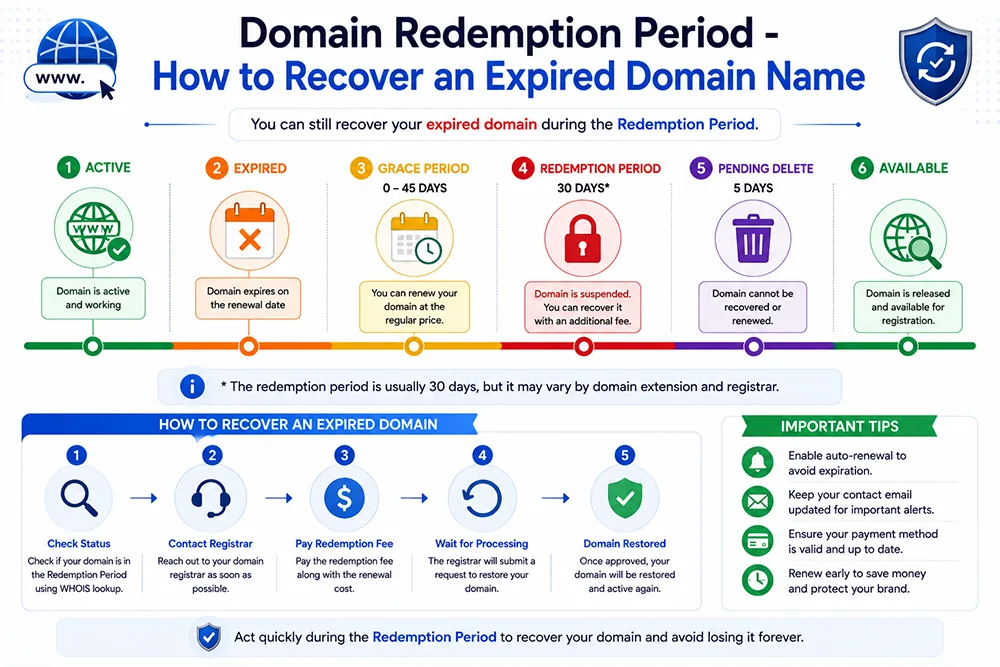
Every domain name goes through a defined lifecycle: Active, Expired, Grace Period, Redemption Period, Pending Delete, and finally Released. Understanding this lifecycle helps you act quickly if a renewal is missed. Most domain owners are unaware of these stages until they are already in a costly redemption situation. Webomatic educates all clients about the domain lifecycle to prevent panic and financial loss from missed renewals.
How Much Does Domain Redemption Actually Cost?
Normal annual domain renewal typically costs between Rs. 700 to Rs. 1,500 depending on the extension and registrar. However, during the redemption period, registrars charge a redemption fee set by the domain registry - this can range anywhere from Rs. 3,000 to Rs. 10,000 or more for popular extensions like .com and .in. The exact fee varies by registrar. This is money paid simply to recover a domain you already owned and could have renewed on time.
- Redemption fees for .com domains can be 5 to 10 times more expensive than normal annual renewal.
- The redemption fee is mandated by ICANN and the domain registry - not set by the registrar.
- Some registrars add their own service charge on top of the registry's redemption fee.
- Redemption is only possible within the 30-day redemption window - after that the domain is gone.
- Not all extensions have the same redemption rules - .in redemption policies may differ from .com.
Can You Buy an Expired Domain That Someone Else Let Go?
Yes - once a domain completes the Pending Delete phase and is publicly released, anyone can register it at the normal registration price. Many SEO professionals deliberately target expired domains that already have strong backlinks and domain authority - using them to boost new websites. However, this is a competitive space and popular expired domains are often grabbed by automated drop-catching services within seconds of release.
- Expired domains with existing backlinks and authority can give new websites an SEO head start.
- Drop catching services monitor expiring domains and register them automatically at the moment of release.
- Always check the backlink profile and history of an expired domain before purchasing it for SEO.
- Use tools like Wayback Machine to check what content was previously hosted on an expired domain.
- Webomatic advises clients on whether acquiring an expired domain is beneficial for their SEO strategy.
What is the Impact of Domain Expiry on SEO and Business?
A domain expiry - even for a few days - causes your website to go offline, all email communication to stop, and Google to potentially de-index your pages. If the downtime is extended, you may lose backlinks, search rankings, and customer trust built over years. For businesses that rely on their website for leads, even a few days of downtime can mean significant revenue loss. Webomatic treats domain renewal as a critical business task - not just a technical formality.
- Website downtime from domain expiry causes Google to crawl errors and may drop your search rankings.
- All business email IDs on the expired domain stop working - causing missed client communications.
- Existing backlinks pointing to your domain lose their effect when the domain goes offline.
- Customers who visit an offline website lose trust - many will not return even after the site is restored.
- Consistent domain ownership history is a trust signal for Google and contributes to SEO stability.
The simplest way to avoid all of this is to never let your domain expire. Enable auto-renewal, register for multiple years, and let Webomatic monitor your domain's status on your behalf. We have been managing domain registrations and renewals for businesses across Ahmedabad, Gujarat, and India since 2008 - and not a single Webomatic-managed domain has ever been lost to expiry. Contact us at webomatic.in to get your domain under professional management today.