What is Let's Encrypt - The Free SSL Certificate?
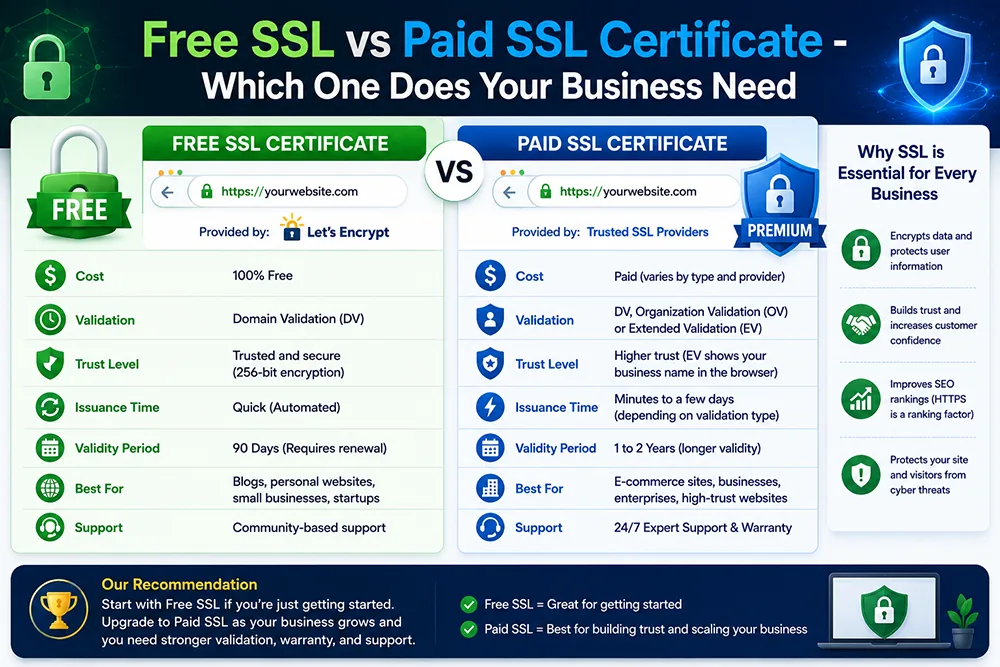
Let's Encrypt is a free, automated, and open certificate authority that provides DV (Domain Validation) SSL certificates at no cost. It is trusted by all major browsers and provides the same encryption strength as paid SSL certificates. Let's Encrypt certificates expire every 90 days and must be renewed automatically. Most quality hosting providers including those used by Webomatic support AutoSSL powered by Let's Encrypt - making it effortless for all client websites to stay secured without any cost.
When is a Free SSL Certificate Sufficient?
A free Let's Encrypt SSL certificate is perfectly sufficient for the vast majority of business websites - including brochure websites, portfolios, blogs, service pages, and most small e-commerce stores. It encrypts the connection between your visitor and your server just as effectively as a paid certificate. The limitation is that it only validates domain ownership - not your business identity. Webomatic uses free SSL by default for all standard client websites - saving clients money without compromising security.
- Free Let's Encrypt SSL provides the same AES-256 encryption as any paid SSL certificate available.
- All major browsers - Chrome, Firefox, Safari, Edge - fully trust Let's Encrypt certificates.
- Free SSL requires auto-renewal every 90 days - most hosting providers handle this automatically.
- For informational business websites, portfolio sites, and blogs - free SSL is completely adequate.
- Webomatic installs and maintains free SSL on all standard client websites at no additional charge.
When Should You Pay for an SSL Certificate?
Paid SSL certificates offer additional validation levels - OV (Organisation Validation) and EV (Extended Validation) - that verify your business identity, not just your domain. EV certificates historically showed a green address bar with your company name - though most browsers have since removed the visual distinction. Paid certificates also come with a warranty against mis-issuance and dedicated customer support. For banks, financial institutions, large e-commerce platforms, and healthcare sites - paid OV or EV SSL is worth the investment for the added trust layer.
- OV SSL verifies your company's legal existence - giving customers more confidence in your legitimacy.
- EV SSL includes the highest level of business identity verification - recommended for financial websites.
- Paid SSL certificates come with a monetary warranty - compensation if the CA (Certificate Authority) makes an error.
- Wildcard paid SSL covers unlimited subdomains - useful for large platforms with multiple subdomain sections.
- Healthcare, legal, and financial websites benefit most from paid OV or EV SSL for compliance and trust.
What Happens When an SSL Certificate Expires?
When an SSL certificate expires, browsers immediately display a full-page warning - "Your connection is not private" - blocking visitors from accessing your website. This is catastrophic for any business. Traffic drops to near zero instantly. For free SSL, auto-renewal handles this automatically when configured correctly. For paid SSL, you must manually renew and reinstall the certificate before expiry. Webomatic monitors SSL expiry for all managed client websites and takes action before any lapse occurs.
- An expired SSL certificate causes browsers to block visitors with a full-page security warning.
- Google may de-index or reduce rankings for pages that repeatedly show SSL certificate errors.
- Set calendar reminders 30 days before your paid SSL expiry date for timely manual renewal.
- Test your auto-renewal setup periodically - auto-renewal can fail silently if server configuration changes.
- Webomatic monitors SSL status for all client websites and alerts clients immediately if any issue is detected.
Whether you use a free or paid SSL, what matters most is that your website is always running on HTTPS with a valid, correctly configured certificate. For most businesses in India, free SSL is entirely sufficient. For financial or high-trust platforms, consider upgrading to OV or EV. Webomatic handles all SSL installation, configuration, and monitoring for clients across Ahmedabad, Vadodara, Surat, Rajkot, and India. Contact us at webomatic.in today.