What is SQL Injection and How Do Hackers Use It?
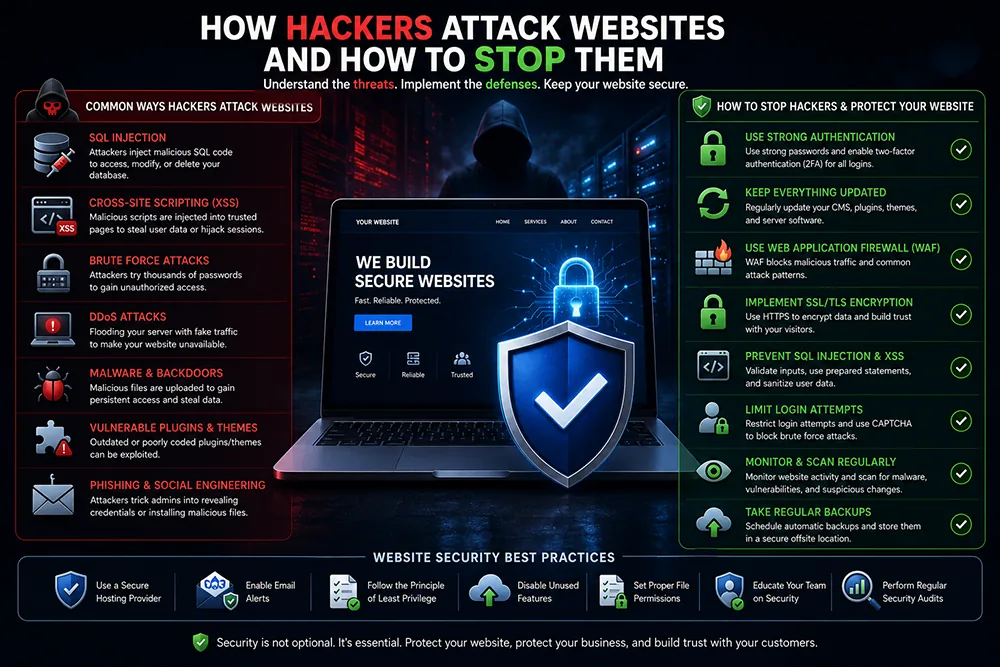
SQL injection is one of the most common and dangerous website attacks. It happens when a hacker enters specially crafted text into a form field - like a login box or search bar - that tricks the database into running unauthorised commands. This can expose customer data, allow unauthorised login, or even delete your entire database. Webomatic uses parameterised queries and input validation on all client websites to prevent SQL injection from being possible in the first place.
What is Cross-Site Scripting (XSS) and Why is it Dangerous?
Cross-Site Scripting (XSS) is an attack where a hacker injects malicious JavaScript into a web page that is then executed in the browsers of visitors who view that page. It can steal session cookies, redirect users to fake login pages, or silently collect form data. XSS attacks are especially dangerous on websites with user-generated content, comment sections, or contact forms. Webomatic sanitises all output and uses Content Security Policy (CSP) headers to prevent XSS attacks on client websites.
- XSS attacks target your website visitors - not just your server data - making them especially harmful to trust.
- Stored XSS is the most dangerous type - the malicious script is saved in your database and runs repeatedly.
- Always encode output data in HTML - never display raw user input directly on any web page.
- Content Security Policy (CSP) headers restrict which scripts can run on your pages - blocking XSS effectively.
- Webomatic implements output encoding and CSP headers on all client websites to prevent XSS vulnerabilities.
What are Brute Force Attacks and How to Block Them?
A brute force attack is when a hacker - or more commonly an automated bot - tries thousands or millions of username and password combinations to gain access to your website admin panel, cPanel, or email accounts. Weak passwords like "admin123" or your company name are cracked within seconds. Defences include: limiting login attempts, adding CAPTCHA, using two-factor authentication, and changing default admin usernames. Webomatic locks down admin login pages for all client websites to prevent brute force access attempts.
- Bots can attempt thousands of password combinations per minute - weak passwords provide no real protection.
- Limit login attempts to 5 or fewer - lock the IP for 30 minutes after repeated failures to slow attackers down.
- Change default admin username from "admin" to something unique - "admin" is always the first guess.
- Two-factor authentication makes brute force attacks practically useless - even with the correct password.
- Webomatic implements login attempt limits and 2FA recommendations for all client website admin panels.
What is a DDoS Attack and Can a Small Business Be Targeted?
A Distributed Denial of Service (DDoS) attack floods your web server with so much fake traffic that it becomes overwhelmed and your website goes offline for legitimate visitors. Yes - small businesses in India are targeted too, sometimes by competitors or simply by automated botnets scanning for vulnerable servers. Defences include CDN services (like Cloudflare) that absorb attack traffic before it reaches your server, rate limiting, and firewall rules. Webomatic recommends Cloudflare for all client websites as a baseline DDoS protection measure.
- DDoS attacks do not need to break into your site - they just overwhelm it until it crashes for real users.
- Cloudflare's free plan offers basic DDoS protection and is recommended for every business website in India.
- Rate limiting on your server blocks IPs sending abnormally high numbers of requests per second.
- A CDN distributes your website globally - spreading traffic load and absorbing attack volume effectively.
- Webomatic recommends and helps configure Cloudflare for clients who want baseline DDoS protection.
Hackers do not always target specific businesses - most attacks are automated and opportunistic, targeting any vulnerable site they can find. The best defence is a well-built, regularly updated, and properly hardened website. Webomatic builds secure websites and provides ongoing security support for businesses across Ahmedabad, Vadodara, Surat, Rajkot, and all of India. Contact us at webomatic.in or call +91 99249 43005 today.