
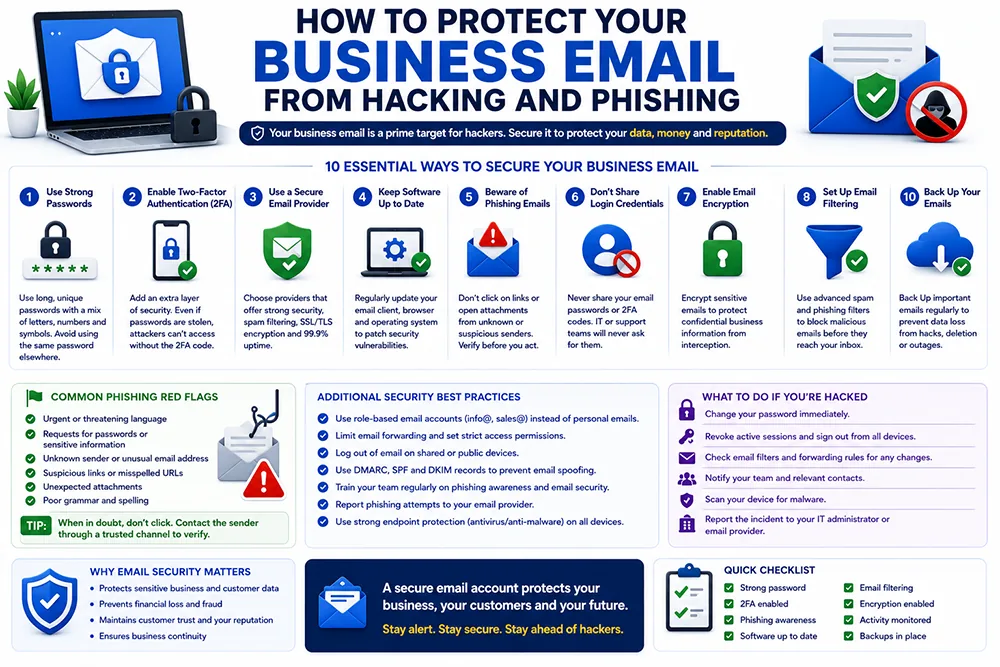
What are the Most Common Email Security Threats for Businesses?
Business email is one of the most targeted attack surfaces for cybercriminals. The most common threats include phishing (fake emails that steal credentials), email spoofing (sending emails that appear to be from your domain), Business Email Compromise (BEC) where attackers impersonate executives, spam campaigns, and malware-laden attachments. In India, BEC and phishing attacks targeting small businesses have risen sharply. Webomatic educates all clients on these threats and helps configure defences as part of every email setup.
What is Email Spoofing and How Do SPF, DKIM, DMARC Prevent It?
Email spoofing is when a criminal sends emails that appear to come from your legitimate domain - tricking your clients or employees into revealing sensitive information or making payments. SPF (Sender Policy Framework) specifies which mail servers can send email from your domain. DKIM adds a cryptographic signature to emails to verify authenticity. DMARC tells receiving servers what to do with emails that fail SPF or DKIM checks. Webomatic configures all three DNS records for every client email domain to prevent spoofing attacks.
- SPF record in DNS authorises specific mail servers to send email on behalf of your domain name.
- DKIM signs outgoing emails with a private key - recipients verify it using your public key in DNS.
- DMARC policy (p=quarantine or p=reject) tells servers to block or flag emails that fail authentication.
- Without SPF and DKIM, anyone can send emails appearing to be from your business domain.
- Webomatic configures SPF, DKIM, and DMARC for all client domains as standard email security practice.
How to Recognise a Phishing Email Targeting Your Business?
Phishing emails are designed to look legitimate - often mimicking banks, hosting providers, Google, or even your own colleagues. Warning signs include: an email address that does not match the sender's organisation, urgent language demanding immediate action, suspicious links when you hover over them, requests for passwords or OTPs, and unexpected attachments. Never click a link in an email without verifying the sender. Webomatic trains clients to identify phishing attempts and avoid costly security breaches.
- Always check the actual sender email address - not just the display name shown in the email.
- Hover over links before clicking - the URL shown in the status bar reveals the real destination.
- No legitimate company will ever ask for your password, OTP, or card details via email.
- Be suspicious of any email creating extreme urgency - "Act now or your account will be suspended."
- When in doubt, call the sender directly on a known number - never reply to the suspicious email.
How to Secure Your Business Email Account Against Hackers?
Strong passwords and two-factor authentication (2FA) are the first line of defence. Use a password of at least 12 characters with uppercase, lowercase, numbers, and symbols - and never reuse it on multiple accounts. Enable 2FA on your email account so even if someone steals your password, they cannot log in without your phone. Update passwords every 3 to 6 months. Never share your email password via WhatsApp or email. Webomatic insists on strong passwords for all client email accounts from day one of setup.
- Use a password of at least 12 characters combining letters, numbers, and special characters always.
- Enable 2FA on your email and cPanel login - it makes brute-force and credential attacks ineffective.
- Never share email passwords via WhatsApp, SMS, or email - use a secure password manager instead.
- Revoke email access immediately when an employee who had credentials leaves your organisation.
- Webomatic recommends and enforces strong password policies for all client email and hosting accounts.
Email security is not a luxury - it is a necessity for every business in India today. A single compromised email account can lead to financial fraud, data theft, and reputation damage that takes years to recover from. Webomatic helps businesses across Ahmedabad, Vadodara, Surat, Rajkot, and all of India secure their email infrastructure with proper SPF, DKIM, DMARC, and account security practices. Contact us at webomatic.in today.