What is an SSL Certificate?
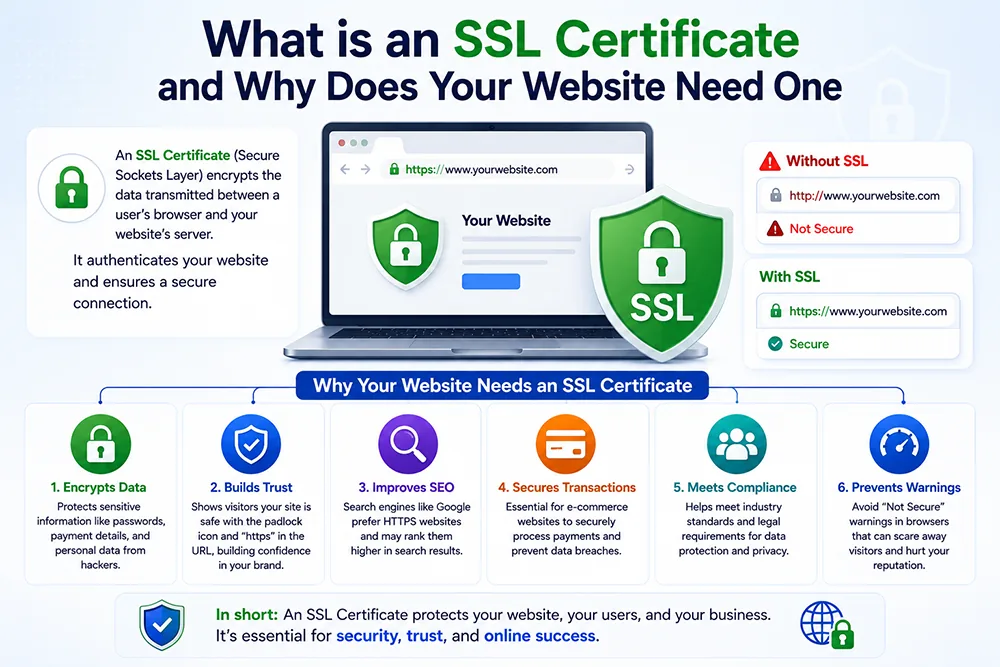
SSL (Secure Sockets Layer) is a digital certificate that encrypts the connection between a visitor's browser and your web server - ensuring all data transferred (like form submissions, login details, or payment information) is protected from interception. When a website has SSL installed, its URL starts with HTTPS and shows a padlock icon in the browser address bar. Webomatic installs and configures SSL on every client website as a non-negotiable part of the launch process.
Why Does Google Penalise Websites Without SSL?
Google Chrome marks all HTTP websites as "Not Secure" in the address bar - a warning that immediately destroys visitor trust. Google's search algorithm also gives a ranking advantage to HTTPS websites over HTTP ones. Running a website without SSL in 2025 means lower search rankings, higher visitor drop-off rates, and the inability to run Google Ads or Meta Ads campaigns on certain pages. Webomatic has not launched a single client website without SSL since it became a standard requirement.
- Google Chrome displays a "Not Secure" warning for all HTTP websites - destroying visitor confidence instantly.
- Google search ranking algorithm uses HTTPS as a positive ranking signal for all indexed pages.
- Meta Ads and Google Ads require landing pages to be on HTTPS - HTTP pages cannot run paid campaigns.
- SSL encrypts form data - contact forms, login forms, and payment details are protected from interception.
- Visitors are 85% more likely to abandon a purchase on a website showing a "Not Secure" warning.
What are the Different Types of SSL Certificates?
There are three main types of SSL certificates: DV (Domain Validation) - the most basic, verifying only domain ownership; OV (Organisation Validation) - verifying your business identity; and EV (Extended Validation) - the highest level, showing your company name in the browser bar. Free SSL certificates like Let's Encrypt are DV-level and are sufficient for most business websites. Paid OV and EV certificates are recommended for e-commerce and financial platforms. Webomatic installs the appropriate SSL type based on each client's needs.
- Let's Encrypt offers free DV SSL certificates - suitable for most business and informational websites.
- OV SSL certificates verify your company identity - showing your organisation name in certificate details.
- EV SSL certificates display your company name in the browser address bar - highest level of trust.
- Wildcard SSL covers your main domain and all its subdomains under a single certificate.
- Multi-domain SSL (SAN) covers multiple different domains under a single certificate - cost effective.
How to Check if a Website Has SSL Installed Correctly?
Visit your website and check the browser address bar - you should see HTTPS and a padlock icon. Click the padlock to see certificate details including who issued it and its expiry date. You can also use free tools like SSL Labs (ssllabs.com/ssltest) to run a comprehensive SSL check. Common issues include mixed content warnings (when some page elements still load over HTTP), expired certificates, and incorrect redirect configurations. Webomatic checks and verifies SSL configuration for all client websites before and after launch.
- HTTPS and a padlock icon in the browser address bar confirm SSL is installed and working correctly.
- SSL Labs (ssllabs.com) gives a detailed SSL health report including grade, vulnerabilities, and configuration.
- Mixed content warning means some images or scripts still load over HTTP - breaking full HTTPS protection.
- SSL certificates expire - typically every 90 days for free or 1-2 years for paid certificates.
- Webomatic monitors SSL expiry for all managed client websites and renews before any lapse occurs.
SSL is no longer optional - it is the foundation of a trustworthy, secure, and search-engine-friendly website. Whether you are running a business brochure site, an e-commerce platform, or a blog - HTTPS is mandatory. Webomatic installs, configures, and monitors SSL for all client websites across Ahmedabad, Vadodara, Surat, Rajkot, and all of India. Visit webomatic.in to ensure your website is secured correctly today.