What is On-Page SEO?
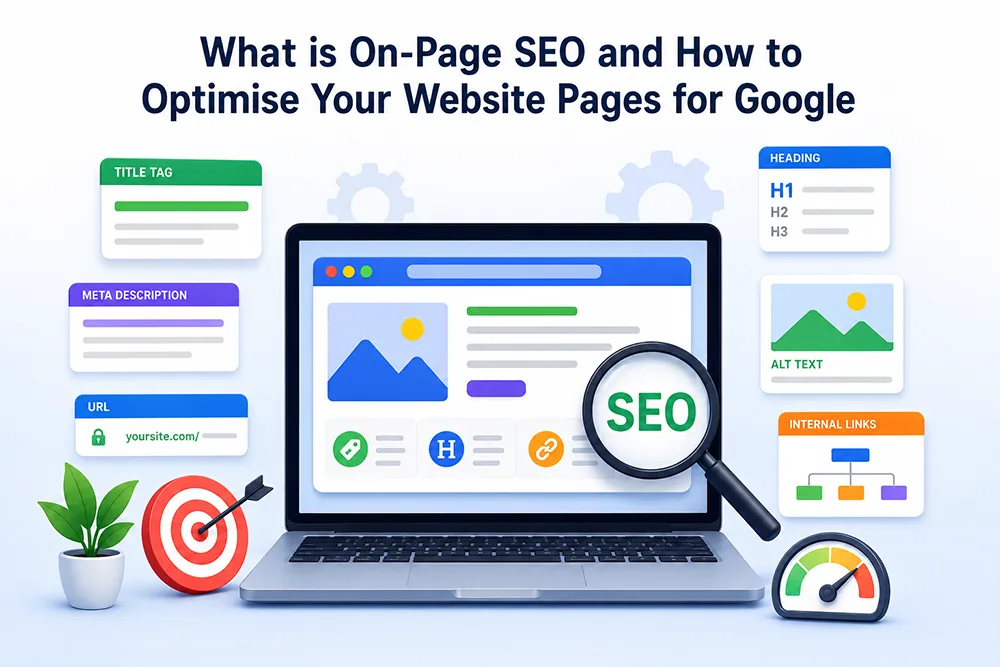
On-page SEO refers to all the optimisation techniques applied directly on your website pages to improve their visibility in Google search results. This includes your title tags, meta descriptions, heading structure (H1, H2, H3), page content, image alt text, URL structure, internal links, and page load speed. Unlike off-page SEO (backlinks), on-page SEO is entirely within your control. Webomatic applies comprehensive on-page SEO optimisation to every client website as part of both the initial build and ongoing SEO maintenance.
Title Tags and Meta Descriptions - Your First Impression in Google
The title tag is the clickable headline that appears in Google search results. It is one of the most important on-page SEO elements. Each page should have a unique title tag of 50 to 60 characters that includes the primary keyword and clearly describes the page. The meta description - the short text below the title in search results - does not directly affect rankings but significantly impacts click-through rate. Write it as a compelling summary (150 to 160 characters) that encourages users to click. Webomatic writes optimised title tags and meta descriptions for every page on client websites.
- Each page must have a unique title tag - duplicate titles confuse Google and hurt your overall rankings.
- Place the primary keyword near the beginning of the title tag for maximum relevance signal.
- Keep title tags between 50 and 60 characters - longer ones get cut off in Google search results.
- Write meta descriptions as genuine ad copy - a good description significantly improves your click-through rate.
- Webomatic writes unique, keyword-optimised title tags and meta descriptions for every client website page.
Heading Structure - How H1, H2, and H3 Tags Affect SEO
Every page should have exactly one H1 tag - typically the main page title - that includes the primary keyword. H2 tags are used for main section headings and should contain related secondary keywords. H3 tags break down sub-sections further. This heading hierarchy helps both Google understand your content structure and readers navigate the page. A page with no headings or improper heading structure is harder for Google to parse correctly. Webomatic applies correct heading hierarchy to all pages during the website build.
- Every page should have exactly one H1 tag containing the primary keyword for that page.
- H2 tags should contain secondary and related keywords - naturally, not forced or repetitive.
- Never use heading tags for visual styling - use them semantically to indicate actual content hierarchy.
- Google uses heading structure to understand content topic and relevance to search queries.
- Webomatic implements correct H1-H2-H3 heading structure on every client website page during development.
Content Quality and Keyword Usage in On-Page SEO
Google's algorithms have become sophisticated enough to understand topic depth and semantic relevance - not just keyword stuffing. Each page should cover its topic comprehensively, use natural language, and include related terms (LSI keywords) alongside the primary keyword. Aim for at least 300 to 500 words for service pages and 800 to 1,500 words for blog posts. Avoid keyword stuffing - it actually hurts rankings. Write for humans first, then ensure the content signals clearly to Google what the page is about. Webomatic writes SEO-optimised content for all client website pages.
- Write content that genuinely answers what your target audience searches for - not just keyword-filled text.
- Use the primary keyword naturally in the first 100 words of your page content for a relevance signal.
- Include related terms and synonyms - Google understands topic clusters, not just exact keyword matches.
- Service pages need minimum 300 words of unique content - thin content pages rarely rank on Google.
- Webomatic writes comprehensive, keyword-optimised content for every service and blog page on client websites.
On-page SEO is the foundation of every successful Google ranking strategy. Without getting the basics right - title tags, headings, content, and structure - no amount of backlinks will take you to page 1. Webomatic implements full on-page SEO optimisation for businesses across Ahmedabad, Vadodara, Surat, Rajkot, and all of India. Contact us at webomatic.in to get your website's on-page SEO reviewed and improved today.