
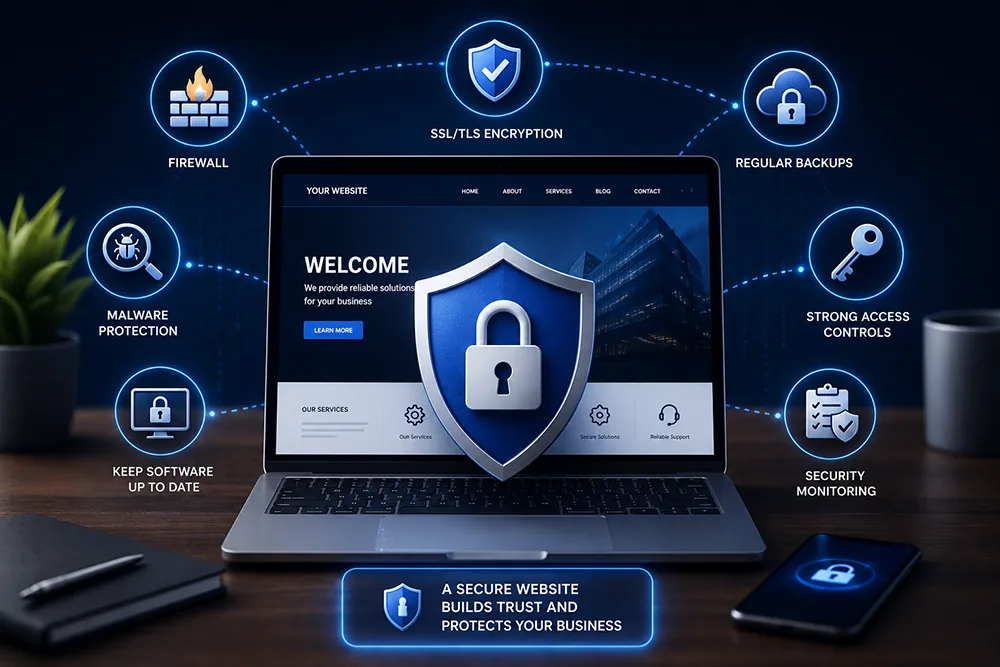
What is Web Security?
Web security refers to the practices, tools, and protocols used to protect a website and its data from cyber threats - including hacking, malware, DDoS attacks, data theft, and unauthorised access. A secure website protects your business data, your customer data, and your online reputation. Webomatic builds security into every website it designs - from SSL installation to clean code practices and server-level protections.
What are the Most Common Website Security Threats in India?
Indian businesses face a growing range of web security threats. The most common include SQL injection (attackers manipulating database queries through form inputs), Cross-Site Scripting (XSS - injecting malicious scripts into web pages), brute-force attacks on login pages, malware injections that redirect visitors to phishing sites, DDoS attacks that overwhelm servers, and data breaches through unsecured form submissions. Webomatic follows secure coding practices to protect against these threats in every client website.
- SQL injection attacks exploit unsanitised form inputs to manipulate or steal database data.
- XSS attacks inject malicious JavaScript into web pages viewed by unsuspecting site visitors.
- Brute-force attacks try thousands of password combinations to gain admin login access.
- DDoS attacks flood your server with fake traffic to make your website slow or completely inaccessible.
- Webomatic follows OWASP secure coding guidelines for all client website development projects.
How Does Webomatic Protect Client Websites from Hackers?
Webomatic implements multiple layers of security for every client website: SSL installation and HTTPS enforcement, clean PHP code with input validation and sanitisation, server-level firewall configuration, strong admin passwords, file permission hardening, and regular malware scanning. For WordPress sites, Webomatic also installs security plugins, disables file editing from the admin panel, and limits login attempts. Security is built-in from the start - not patched on later.
- Always validate and sanitise all user inputs on forms to prevent SQL injection and XSS attacks.
- Limit login attempts on your admin panel to prevent brute-force password guessing attacks.
- Set file permissions correctly - PHP files should be 644 and directories 755 on Linux servers.
- Use a Web Application Firewall (WAF) to filter malicious requests before they reach your website.
- Webomatic implements all security hardening measures for client websites during design and post-launch.
What Should You Do if Your Website is Already Hacked?
If your website is hacked - take it offline immediately to prevent visitor harm. Notify your hosting provider. Restore from the most recent clean backup. If no backup exists, perform a manual malware scan and cleanup using tools like Wordfence or Imunify360. Change all passwords - hosting, FTP, CMS admin, and database. Identify the entry point and patch it. Webomatic provides emergency website recovery services for hacked client and non-client websites across Gujarat and India.
- Take the hacked website offline immediately to protect visitors from malware or phishing redirects.
- Restore from the most recent clean backup - this is the fastest way to recover a hacked website.
- Scan all website files for malware using server-level tools like Imunify360 or ClamAV after recovery.
- Change all passwords after a hack - the attacker may have obtained credentials during the breach.
- Webomatic provides emergency hack recovery and post-incident security hardening for client websites.
Website security is not a one-time task - it is an ongoing responsibility. Every business with an online presence needs to take it seriously. Webomatic builds secure websites and provides security monitoring for businesses across Ahmedabad, Vadodara, Surat, Rajkot, and all of India. Contact us at webomatic.in to get your website security reviewed today.